Image Source: vecteezy.com
Greetings, Earthlings!
Are you ready for some fireworks?
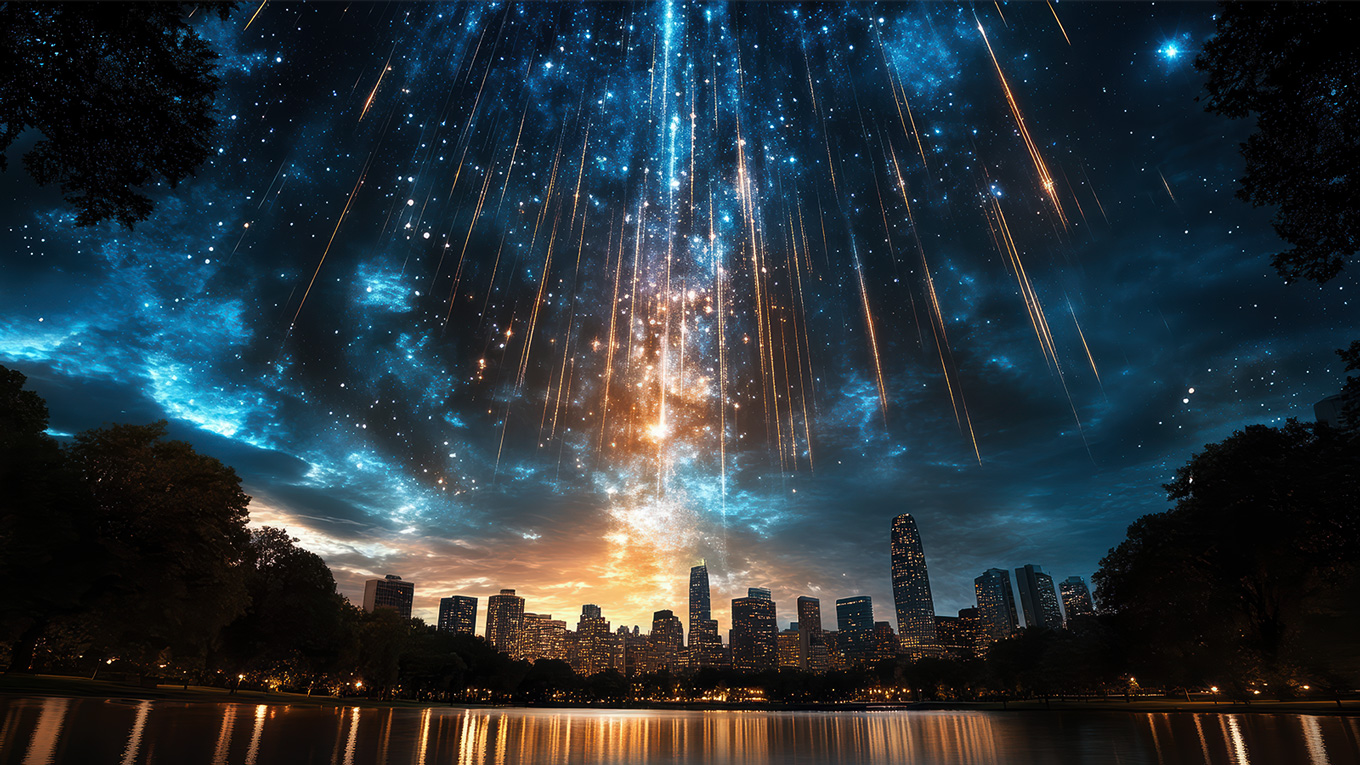
It’s that time of year once again. August brings warm nights, perfect for late-summer campers eager to witness the annual spectacle of the Perseids meteor shower.
When the sky delivers one rare event after another, it feels less like coincidence and more like a message. A Total Solar Eclipse setting the stage for the Perseid meteor shower peak creates exactly that kind of moment—one that invites us to look up, slow down, and remember how beautiful change can be.
A Total Solar Eclipse followed by the Perseid meteor shower peak is more than a beautiful skywatching event—it is the kind of cosmic timing that makes people feel the deep pulse of the Universe. Eclipses often symbolize resets, revelations, and unexpected turns, while meteor showers remind us that brilliance can arrive in flashes that are brief but unforgettable. Together, they create a moment that feels charged with meaning: a sky that asks you to release what has run its course and stay open to what is trying to reach you. It is the kind of cosmic display that can stir reflection, hope, and a renewed sense of possibility. Sometimes the most powerful changes do not begin with noise—they begin with a quiet shift overhead.
Related:
- 2026’s Full Buck Moon in Aquarius Spiritual Meaning
- Let’s Breathe a Collective Sigh of Relief: Mercury Goes Direct in Cancer
- Get Ready for a Wave of Intense Energies: Aquarius Full Moon Heralds the Lionsgate Portal
- July 2026 Astrology Through Dates: Sadly, Two New Retrogrades Are Coming
- July Horoscope 2026: Ready or Not, a Reality Check Is Coming Either Way
- Jupiter in Leo 2026: Playing Small Is No Longer an Option
Perseid Meteor Shower 2026
- Predicted Peak: The peak is predicted for 14:53 UTC (Universal Time) on August 13th, 2026. So, the mornings of August 12th and 13th are probably your best options. August 14th might be good as well, but be aware that the Perseids tend to fall off rapidly after their peak.
- When to Watch: The Moon will be a New Moon phase during 2026’s peak of the Perseid meteor shower. So, you’ll have dark skies for meteor viewing. This shower rises to a peak gradually, then falls off rapidly. And Perseid meteors tend to strengthen in number as late night deepens into the wee hours before dawn. The shower is often best just before dawn.
- Radiant: The radiant rises late in the evening and is highest at dawn.
- Nearest Moon Phase: The New Moon falls at 17:37 UTC on August 12th. In fact, those lucky enough to be observing the August 12th Total Solar Eclipse, might see some Perseids during totality.
- Duration of Shower: July 14th to September 1st. This time period is when we’re passing through the meteor stream in space!
- Expected Meteors at Peak, Under Ideal Conditions: Under a dark sky with no Moon, skywatchers frequently report 90 meteors per hour, or more. In 2026, you’ll have a moonless sky to watch for Perseids. The August Perseid meteor shower is rich and steady, from early August through the peak. The meteors are colorful, and many of them are bright. And they frequently leave persistent trails. All of these factors make the Perseid shower perhaps the most beloved meteor shower in the Northern Hemisphere.
Perseid Meteor Shower Radiant Point
During the peak mornings, if you follow the path of all the Perseid meteors in the backward direction, they appear to originate from the constellation Perseus, close to the renowned Double Cluster. Thus, the meteor shower takes its name from the legendary constellation Perseus the Hero.
Certainly, there’s no genuine link between the meteor shower’s radiant and the constellation Perseus. The stars in Perseus shine from countless light-years away, while these meteors blaze through the atmosphere at an altitude of around 60 miles (100 km) above our planet’s surface.
See Also:
- The Aquarius Full Buck Moon Does Not Ask Where You Belong; It Asks What Belonging Has Cost You
- The Nodes of Fate & Destiny Are Changing Signs: Your Soul Is Entering a Powerful New Timeline
- Leo Season 2026: Time to Unleash Your Inner Baddie
- Venus in Libra 2026: Open Up Your Heart Chakra
- Chiron in Taurus: Your Wounds & Scars Are Becoming Your Greatest Power
- Uranus in Gemini 2026-2033: Life Will Never be the Same Again
- Pluto Retrograde in Aquarius: Less Forward Motion, More Internal Excavation
The Perseids’ Parent Comet
From the late, legendary Don Machholz (1952-2022), who discovered 12 different comets …
The parent comet that gives rise to the dazzling Perseid meteor shower is a significantly larger comet known as 109P/Swift-Tuttle. The comet makes its grand journey around the Sun roughly once every 133 years. Lewis Swift from Marathon, New York, made a visual discovery on July 16, 1862, using an 11-centimeter (4.3-inch) refractor lens telescope. He chose not to report it right away, thinking he was witnessing Comet Schmidt, which had been discovered just two weeks earlier. Three days later, Horace Tuttle picked it up from the Harvard Observatory. Researchers determined that the comet is set to make its return in 120 years. That is, that we would see it again in 1982.
Well, 1982 has come and gone, leaving its mark in the sands of time. And the comet was a no-show. Whoops! It was time to revisit the drawing board, and this time, the sighting of a comet in 1737 was taken into account as a potential early manifestation of the comet. Now, the orbital period was approximately 130 years. Brian Marsden released updated orbital elements and an ephemeris detailing the location for its return in 1992.
During the 1980s, a group of us passionate visual comet hunters would occasionally scan the skies, eagerly searching the area where the anticipated comet was expected to make its grand entrance. The 1991 surge of Perseid meteors suggested that the comet was likely making its return journey. Another meteor outburst in 1992 appeared to validate that notion.
On the evening of September 26, 1992, Tsuruhiko Kiuchi, an enthusiastic amateur astronomer and comet seeker, spotted the comet shining brightly just north of the Big Dipper’s bowl. After pinpointing the right location, I spotted this comet 16 hours later and estimated its brightness to be five times greater than the initial report. Others subsequently validated this. Later, Gary Kronk proposed that the comets seen in 69 BCE and 188 CE were also sightings of this comet, a theory that was later validated.
Related:
- July Brings the Luckiest Day of 2026: The Day of Miracles
- Saturn Retrograde in Aries 2026: Standing at the Edge of a New Chapter
- Lion’s Gate Portal: Things You NEED to Know About the 8/8 Lion’s Gateway!
- Neptune Retrograde in Aries Will Rule Your Life Until the End of 2026
- Chiron in Taurus 2026-2034: A New Healing Chapter Begins
- Saturn Retrograde in Aries Might Trigger an Identity Crisis, But It Could Change Your Life
Do Perseid Meteors Ever Hit the Earth’s Surface?
Meteors that reach the Earth’s surface without breaking apart are known as meteorites. However, very few—if any—meteors from annual showers actually transform into meteorites. That’s mainly due to the delicate nature of cometary debris. Comets consist of icy materials. In contrast, the majority of meteorites originate from the remnants of rocky or metallic asteroids.
In the rich tapestry of ancient Greek mythology, Perseus emerges as the offspring of the mighty god Zeus and the beautiful mortal Danaë. Legend has it that the Perseid meteor shower marks the moment when Zeus graced Danaë, the mother of Perseus, with a dazzling shower of gold.
Consider the fleeting beauty of meteors during meteor showers as you gaze up at the Perseids in 2025. Many meteors enter Earth’s atmosphere without anyone noticing. Any Perseid meteor you catch sight of in 2026 is a delightful treat just for you!
See Also:
- An Easy Chakra Clearing Ritual for July’s Aquarius Full Moon
- Saturn Retrograde 2026: Karma Is Coming to Collect the Debts
- Your Destiny Is Changing: North Node in Aquarius & South Node in Leo 2026-2028
- Mars in Cancer 2026: A Rollercoaster of Emotions
- The Shadow Work Era Begins: 2026’s Pluto Retrograde in Aquarius Is Pulling Secrets into the Light
- Saturn in Aries 2026-2028: Discipline Meets Fire in a Defining New Cycle
Experience the Magic of the 2026 Perseids
Observing a meteor shower is surprisingly simple and requires minimal technology. To fully enjoy the Perseids, all you need is a reliable lawn chair, a warm drink, and a touch of patience. A companion can assist in scanning the sky, as the Perseids may emerge from any angle around the radiant.
Choose your observing site wisely to outsmart the Moon (not this year 😉), positioning it behind a nearby hill or building to eliminate its glare.
The Perseids frequently deliver a captivating twin peak, happening just hours apart across the globe. Therefore, it’s definitely worthwhile to keep an eye on the skies during the nights leading up to and following the expected maximum.
The Perseids are remarkable for their stunning fireballs, which can illuminate the night sky with dazzling intensity, often leaving behind a lingering trail of smoke. Some people witnessed a Perseid meteor that produced a remarkable audible hiss.
It has been revealed that meteors can be “heard” through a unique phenomenon called “electrophonic sound.” Set your FM radio to an empty frequency, and you might just catch the intriguing sound of meteor “pings” amidst the static.
Don’t miss the magic of the August Perseids, a must-see meteor shower in 2026.
Happy stargazing!!!
More for You:
- Saturn Retrograde in Aries Is Here: It’s Time to Set Boundaries That Protect Your Inner Peace
- Follow These DOS & DON’TS for Maximizing the Vibes of July’s Full Buck Moon in Aquarius
- 4 Powerful Facts You Need to Know Before the Lion’s Gate Portal Opens
- The Ultimate Guide to Every New & Full Moon in 2026: Twelve Lunar Chapters, Twenty-Four Sacred Moments
- Major Astrological Events That Will Define 2026: A Year of Rare Alignments & Fated Turning Points
- Mercury Retrograde 2026: Dates & Things to Keep in Mind
- Under the Shadow of Fate: Welcome to the 2026 Eclipse Cycle!
- 2026 Horoscope: A Karmic Reset
If our work has made a positive impact on your life, we kindly ask for your support so we can continue our work. Thank you!
Now, you can follow Conscious Reminder on Facebook & Instagram!
∼If you like our article, give Conscious Reminder a thumbs up, and help us spread LOVE & LIGHT!∼