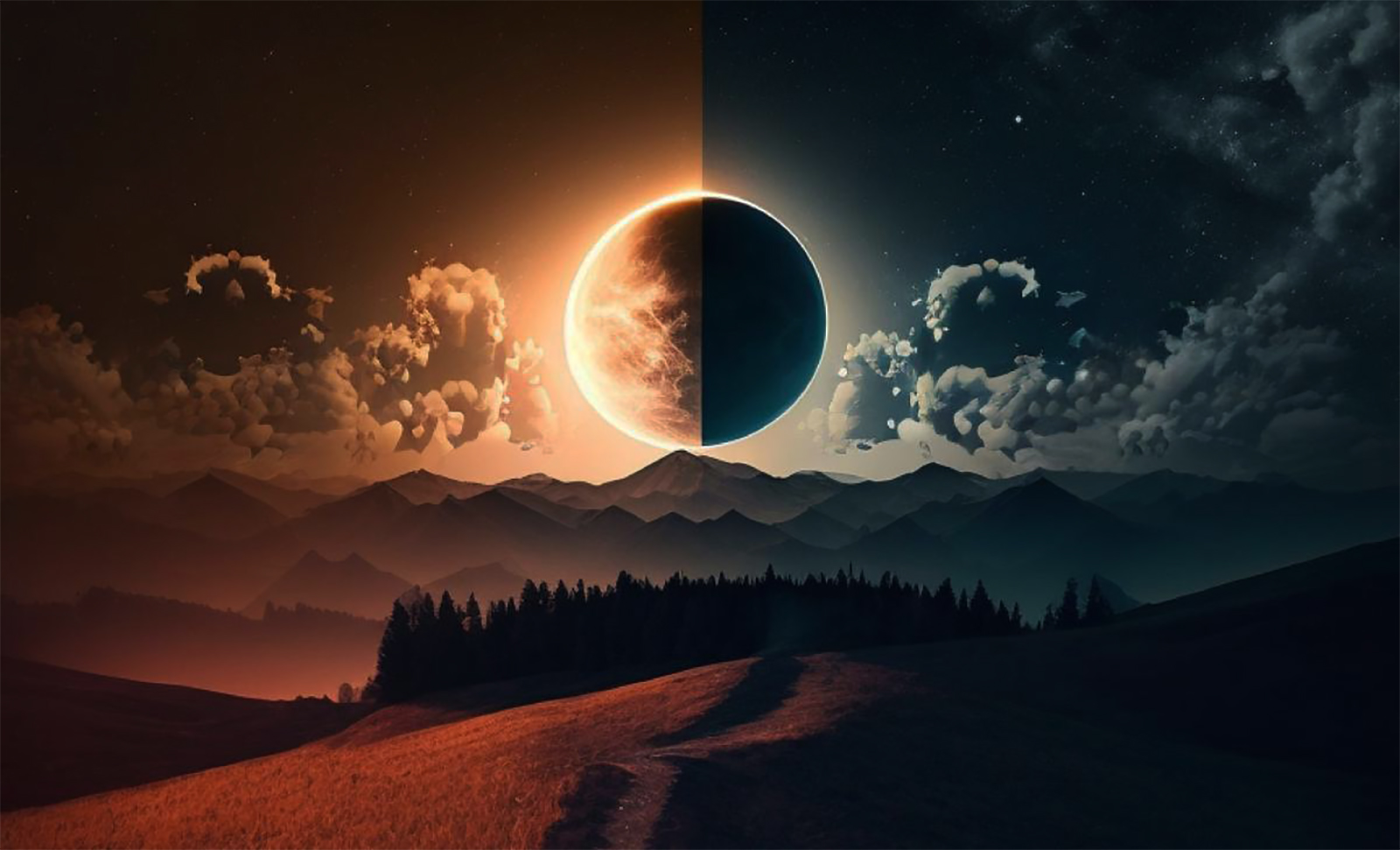
Solstice. Equinox. They are the first words spoken when a new season begins.
The arrival of the Vernal Equinox in late March heralds the arrival of Spring, while the arrival of the Solstice in late December ushers in Winter. Aside from signaling the change of seasons, what do these words actually signify? Does the word “Equinox” mean something different from “Solstice”?
We invite you to join us in delving into these and other inquiries within this guide to the Equinox and Solstice. Remember that the Northern Hemisphere Equinoxes and Solstices will be the primary focus here. A Southern Hemisphere perspective yields a different appearance.
Related: The Ultimate Guide to Every New & Full Moon in 2026: Twelve Lunar Chapters, Twenty-Four Sacred Moments
Mercury Retrograde 2026: Dates & Things to Keep in Mind
Under the Shadow of Fate: Welcome to the 2026 Eclipse Cycle!
Neptune in Aries: 14 Years of Sacred Fire, Vision & Bold Becoming
2026 Horoscope: A Karmic Reset
Equinox vs. Solstice
In Latin, the words “aequus” (meaning “equal”) and “nox” (meaning “night”) combine to form the word “Equinox.” Thus, an Equinox is a day when both the day and the night are of equal length, as the name implies. The same holds true for the arrival of Spring and Fall.
To be more accurate, Equinoxes do not have exactly equal day and night lengths; in fact, the day is still somewhat longer than the night. Day and night are more balanced or symmetrical in the days leading up to the Equinox, on the exact day known as “Equilux.” Just before the Spring Equinox and just after the Fall Equinox, there is a brief period of darkness known as the Equinox.
Conversely, the longest or shortest days of the year are called Solstices. Similar to the Equinox, the Solstice happens twice yearly, marking the beginning of Summer and the beginning of Winter, respectively. Merging the Latin words “sol” (meaning “Sun”) and “sistere” (meaning “to stand still”), the name itself is derived from Latin as well. Naturally, though, the claim that the Sun remains motionless at this hour is false. On Earth, though, we could get that impression.
Equinox vs. Solstice: When Does Each Take Place?
The Northern Hemisphere’s solstices and equinoxes fall on these dates:
- The Spring Equinox—around March 21
- The Summer Solstice—around June 21
- The Fall Equinox—around September 22
- The Winter Solstice—around December 22
These dates are very flexible, as you can see from the list. The Equinoxes and Solstices don’t happen simultaneously in every part of the globe, so their timing varies not only from one year to the next but also from one location to another.
See Also: The Mystical Pisces New Moon Will Bring Out the Wisdom of the Divine Feminine
2026’s First Mercury Retrograde Will Blur the Lines Between Logic & Intuition
Venus in Aries 2026: This Spring, Be the Love You’ve Been Seeking
Saturn in Aries 2026-2028: Discipline Meets Fire in a Defining New Cycle
Major Astrological Events That Will Define 2026: A Year of Rare Alignments & Fated Turning Points
The Equinoxes & Solstices: What Causes Them?
The Sun’s equatorial position causes both the Equinox and the Solstices to occur at specific times each year.
On an Equinox, the lengths of the day and night are nearly equal because the Sun is directly above the Equator. In contrast, Solstices happen when the Sun’s path is most northerly or most southerly from the Equator, depending on the particular Solstice in question:
- At the Summer Solstice, the Sun appears in the northern sky at its farthest point from Earth due to the North Pole’s axial tilt. This is also the time of day when the Sun’s apogee is at its longest, resulting in the highest amount of daylight.
- On the other hand, when the Winter Solstice rolls around, the South Pole is officially the one that’s closest to the Sun. So, the Sun is at its southernmost point in the sky, resulting in the shortest day of the year.
Why Are Equinoxes & Solstices Important?
The most fundamental reason Equinoxes and Solstices matter is that they signal the start of distinct astronomical seasons. For instance, the Winter Solstice signifies the start of Winter, and the Spring Equinox signifies the start of Spring. Traditional farmers and gardeners placed a premium on keeping track of the beginning and ending of each season because it allowed them to better organize their field and farm work.
From a purely cultural standpoint, though, the Equinoxes and Solstices hold equal significance. For a long time, people have rejoiced over these celestial occurrences. They were also thought to hold spiritual importance by many cultures.
The Spring Equinox, for instance, was thought to portend a fresh start and even a rebirth. This led many to believe that this was an ideal time to make adjustments or launch new endeavors. Ostara, the fertility goddess, was also linked to it by the Germanic people. Many believe that her ancient influence can be felt in the way Easter is observed today.
According to legend, Slav and Celt communities would light bonfires to commemorate the Summer Solstice, while Russians would gather for communal baths. Saturnalia, a festival honoring the Roman god of agriculture and time, would take place during the Winter Solstice. On the last day of the Fall Equinox, Japanese Buddhists observed higan, a seven-day festival honoring the dead and their ancestors. They would pay their respects at the graves of their ancestors and say prayers during this time.
Related: March 2026 Astrology Through Dates: Cosmic Whiplash
March 2026 Horoscope: Time to Shake Off the Winter Blues
Mercury Retrograde in Pisces Isn’t Chaos; It’s Your Cosmic Permission to Dream Again
The Year of the Fire Horse 2026: A Powerful Year Where Speed, Strength & Destiny Take the Lead
After the Pause Comes the Miracle: Jupiter Direct in Cancer Is Rewriting Your Story
Hang On, I Thought Each Season Started at a Different Time?
There is some truth to what you said. The meteorological seasons are well-known to most people, and they are distinct from the astronomical ones. Because they are easier to remember and more closely follow the civil calendar, meteorological seasons are probably more widely used.
Seasons in meteorology are determined by yearly temperature cycles, as opposed to astronomical seasons that are dependent on Earth’s axial tilt with respect to the Sun. In addition, there are four distinct seasons that each last exactly three months:
- Spring: March, April, and May
- Summer: June, July, and August
- Fall: September, October, and November
- Winter: December, January, and February
The beginning of every month also marks the beginning of a new meteorological season. For instance, March 1 marks the beginning of Spring, and September 1 marks the beginning of Fall. Clearly, they’re less difficult to keep tabs on.
How to Mark the Next Equinoxes & Solstices
Celebrations of the Equinox and Solstice have long been a part of many cultures’ calendars. If you’re interested in doing the same, we’ve provided some suggestions below for ways you can commemorate and pay tribute to them. Just a reminder that the precise dates and times of each Equinox and Solstice will differ based on where you are.
See Also: Astrological New Year: Kick Off a Wave of New Potential
Mars in Pisces 2026 Is Rewriting the Rules of Ambition
Pisces Season 2026: The Soothing Reset We’ve Been Waiting For
Year of the Fire Horse 2026 Horoscopes: Fast Moves, Fierce Growth & Fearless Decisions
Mercury in Pisces 2026: When Logic Softens & Intuition Takes the Lead
The Spring Equinox
Spring begins with the Spring Equinox, so gardening is a common celebration. Get dirty and reconnect with nature now. Consider growing beets, carrots, and broccoli in your garden.
You could also spring clean your garden. Pull weeds, prune branches, and clean up leaves. Since spring is about new beginnings, you can also change your garden. For instance, add garden accessories or make compost.
Those interested in magic and manifestation may want to set intentions now. Write them in the present tense, like “I’m healthy and fit,” and feel like you’ve achieved them. Use sage to cleanse your home or charge crystals with Moon energy overnight.
The Summer Solstice
The Summer Solstice is the longest day of the year, so you’ll have time to celebrate. Some collect flowers and herbs from their gardens on this day to decorate their homes. Others prefer to plant flowers on this day.
Beginning Summer gardening tasks slowly is also possible. Now may be the time to add mulch or pest-control equipment to your garden. You can also do Sun Salutation sequences or just relax in the Sun with your family.
For Summer manifestation rituals, you can build and dedicate a Sun altar or just open your windows and blinds. Make “let the sunshine in” your mantra.
The Fall Equinox
Garden cleaning is ideal around the Fall Equinox. Throw away dead plants and branches and kill weeds. Spread compost or fertilizers to prepare your garden for other seasons.
Pumpkin carving and cooking are also great in the fall. Alternatively, prepare and store Winter vegetables.
For spiritual reasons, fall is a good time to review your plans and accomplishments. Which aspects of your life make you proud? Which should change? Fall is about transformation, so drive it now.
The Winter Solstice
Winter garden activities are limited. However, you can still prepare for spring. Now is the time to organize your gardening and order seeds for next year.
You can also celebrate by indoor gardening or decorating with Winter plants like holly and mistletoe. Finally, spiritual people can spend the Winter Solstice alone.
Relax, practice self-care, and review the year. Set some New Year’s resolutions afterward. Consider them New Year’s resolutions.
More for You: Venus in Aries Is Here: The Heart Awakens to a Bold New Truth
Venus in Aries: Stop Waiting; Start Loving Boldly
Winter Is Almost Over! A Potent March Equinox Welcomes Spring & Brings Hope
Welcome to the Year of the Fire Horse 2026: When Destiny Rewards the Brave & Bold
Neptune Re-Enters Aries Today, Completely Reshaping Everything
Uranus in Gemini 2025-2033: A Quiet Prelude Before the Storm
If our work has made a positive impact on your life, we kindly ask for your support so we can continue our work. Thank you!
Now, you can follow Conscious Reminder on Facebook & Instagram!
∼If you like our article, give Conscious Reminder a thumbs up, and help us spread LOVE & LIGHT!∼