Image Source: vecteezy.com
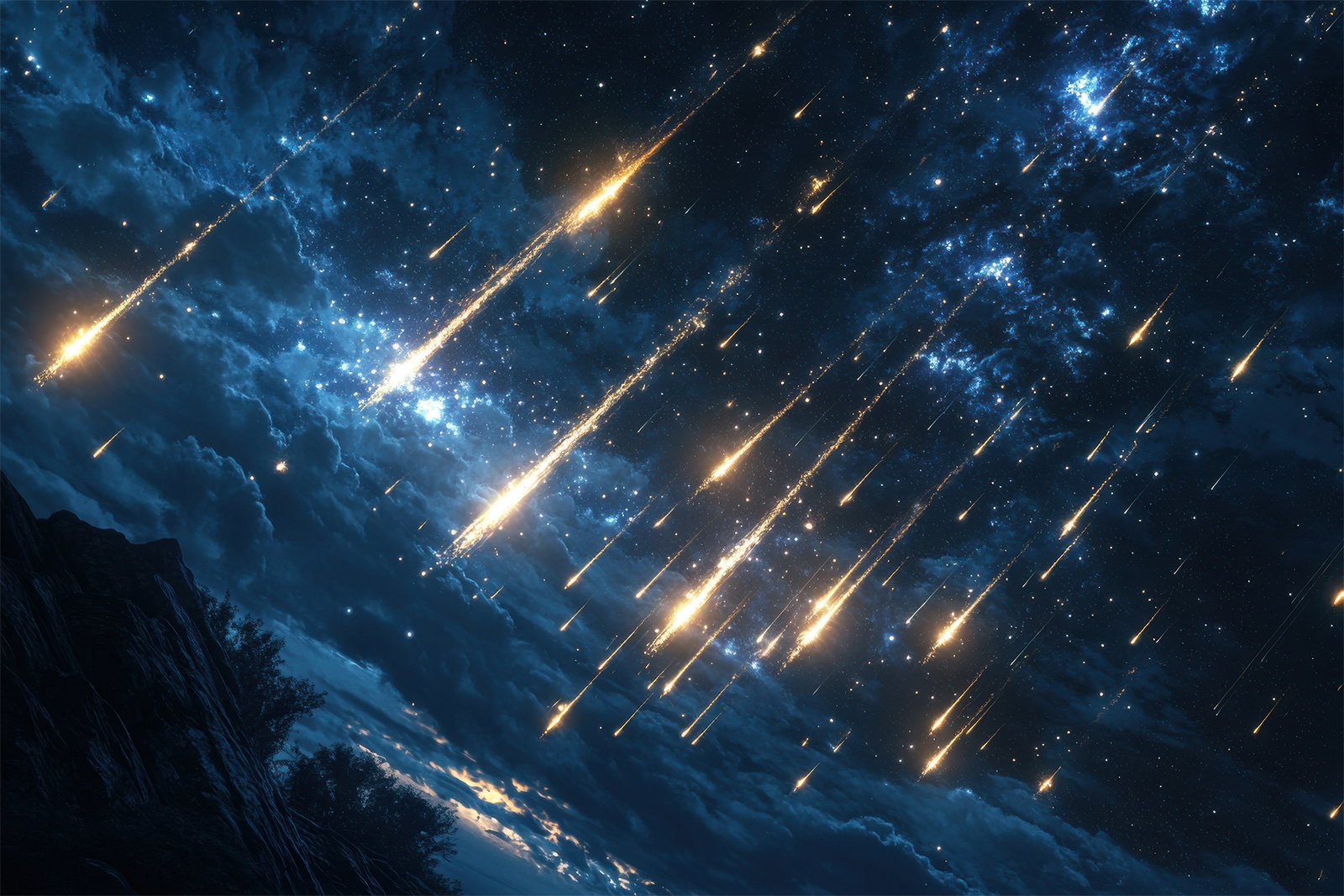
The annual Orionid meteor shower has already started its show.
Orionid meteors become visible when debris from Halley’s Comet collides with Earth’s atmosphere.
Mark your calendars for October 21, 2025, when the Orionid meteor shower is set to dazzle us with its most spectacular display of meteors.
The Orionid Meteor Shower 2025
Predicted peak: The peak is predicted for 00 UTC on October 21, 2025.
When to watch: Watch for Orionid meteors on the morning of October 21, starting after midnight through the wee hours before dawn.
Overall duration of shower: September 26 to November 22. This time period is when we’re passing through the meteor stream in space!
Radiant: The radiant rises before midnight and is highest in the sky around 2 a.m.
Nearest Moon phase: The New Moon falls at 12:25 UTC on October 21. So, at the Orionids’ peak, there’ll be dark skies for observing the meteor shower.
Expected meteors at peak, under ideal conditions: Under a dark sky with no Moon, the Orionids exhibit a maximum of about 10 to 20 meteors per hour.
Note: These fast-moving meteors occasionally leave persistent trains. The Orionids sometimes produce bright fireballs.
Related: October 2025 Astrology Through Dates: Things Are Getting Spooky
Libra Season 2025 Is Here & It’s the Perfect Time to Bring Some Balance to Our Lives
Mars in Scorpio 2025: Your Intuition Will Guide You to Success
Venus in Libra 2025: Open Up Your Heart Chakra
About the Orionids’ Parent Comet…
The Orionid meteors we see originate from Halley’s comet. This comet makes its journey around the sun approximately every 76 years, releasing dust particles from its nucleus like steam billowing from a locomotive, leaving a trail in its wake. Every year, we make our mark on this journey in late October. The comet’s nucleus sheds approximately 3 to 10 feet (1 to 3 meters) of material with every journey through the inner solar system. Spanning 5 by 9 miles (8 by 15 kilometers), it effortlessly endures countless orbits around the Sun.
Halley’s Comet is officially designated as 1P/Halley. The first comet ever to have its return accurately predicted was calculated by none other than Edmond Halley. The comet has consistently reached brightness levels that make it easily observable, with documented sightings dating back to 240 CE. This comet stands out as one of the rare few named not for its discoverer, but for the person who meticulously calculated its orbit.
Halley’s comet stands out among solar system objects with its unique retrograde orbit, circling the Sun in the opposite direction of our own path. The orbit is slightly tilted in relation to ours, causing it to spend the majority of its time beneath the plane of our trajectory. At this moment, it stands at its most distant position from the Sun, located near the head of the constellation Hydra the Water Snake, and is too faint to be visible.
Related: Liberating New Moon in Libra Rises October 21st: Give Maturity a Voice
Mars in Scorpio 2025 Is Here: Power Returns!
Uranus Retrograde 2025: Finally, a Positive Retrograde
Libra Season 2025 Will Bring Deep, Hidden Secrets to Light
Venus in Libra: The Long-Awaited Harmony
Two Stunning Meteor Showers
The Orionids originate from the particles of Halley’s comet during its approach to the Sun. As they advance in one direction, we head almost in the opposite way, and the result is a spectacular display of fast-moving meteors. However, we also come across its particles during its outbound journey as it departs from the inner Solar System. We arrive at that moment in early May. The Eta Aquariid meteor shower is produced by them. This comet produces two spectacular meteor showers.
Halley’s comet graced our skies in 1986 and is set to make its next appearance in 2061. The Orionids are always present. They arrive without fail each October. Step outside and catch a glimpse of this renowned comet.
Orionid Meteor Shower Peaks Near October’s New Moon
The optimal viewing hours for the Orionids meteor shower are typically between midnight and dawn. In 2025, the peak of the Orionids will be graced by dark skies, thanks to the New Moon.
The phrase “meteor shower” may evoke the image of a rain shower. However, only a handful of meteor showers bear any resemblance to rain showers. The Orionids may not be the most powerful meteor shower of the year, after all. Additionally, they aren’t especially recognized for delivering surprising, lavish displays. In a secluded spot, you could witness an impressive display of 10 to 20 Orionids each hour at their peak. When it comes to meteor showers, there’s always an intriguing mix of uncertainty and the potential for surprise.
Related: Arcturus Gateway: Get Ready for a Powerful Wave of Energies
Mercury in Scorpio 2025: Deep Talks, Dark Secrets & Unseen Powers
It’s Halloween Season & the Veil Is Lifting: Here’s What the Shadow Can Teach Us
Saturn RX Re-Enters Pisces, Encouraging Us to Re-Walk Certain Paths of Surrender, Compassion & Faith
Chiron Retrograde: Perfect Healing Recipe for the Rest of 2025
The Orionids Streak Across the Night Sky
Should you catch a glimpse of the Orionids in 2025, remember that these meteors are renowned for their incredible speed, hurtling into Earth’s atmosphere at approximately 41 miles per second (66 km/s). This meteor shower features some rather subtle displays. However, they compensate for their subtlety by creating trains, or ionized gas trails, that linger for a few seconds after the meteor has disappeared. Approximately fifty percent of the Orionid meteors create lasting trails.
Occasionally, an Orionid meteor may shine with extraordinary brightness and shatter into dazzling fragments.
Orionid Meteors Radiate from Constellation Orion
How can you identify if the meteor you observe is an Orionid? You’ll recognize it by the shower’s brilliant source of light. Meteors during annual showers derive their names from the celestial point in our sky where they seem to originate. The dazzling origin of the Orionids can be found in the iconic constellation Orion the Hunter, which gracefully rises in the eastern sky in the hours following midnight throughout October. Thus, the name Orionids is derived.
You don’t have to be familiar with Orion or gaze directly at it to witness the meteors. Meteors typically remain hidden from view until they reach an angle of about 30 degrees from their radiant point. And, keep in mind, they are radiating outward in every direction. They will be visible throughout the entire sky.
However, if you happen to spot a meteor and trace its trajectory back, you may discover that it originates from the constellation of Orion. If that’s the case, then that meteor will be an Orionid. Chances are, you’re familiar with the dazzling, reddish star Betelgeuse in Orion. The radiant lies to the north of Betelgeuse.
Related: Pluto Goes Direct: A Moment for Radical Courage & Soul Revolution
Jupiter Retrograde 2025: It’s Definitely Nothing Like Notorious Mercury
October 2025 Horoscope: Perfect Autumn Reset After the Tumultuous Eclipse Season
Decadent Venus Enters Virtuous Virgo: Healing Through Sacred Love
Juno in Sagittarius 2025: Love Beyond Borders
Look in Every Possible Direction
So, where do you set your sights? No specific guidance. Seek out a spacious viewing area for the best experience. At times, friends enjoy gathering for a shared viewing experience, each looking in their own unique direction. When someone spots one, they can shout out, “Meteor!”
Conclusion
Mark your calendars for the morning of October 21, 2025, when the Orionid meteor shower is set to dazzle with its most spectacular display of meteors. In 2025, the Moon will take a backseat.
Could this be the year we finally witness a spectacular meteor shower? Let’s wait and see.
Happy stargazing!!!
More for You: Mercury in Scorpio: Spilling Out the Bitter Truths
Uranus Retrograde 2025: Shakeups, Breakups, Breakdowns, & Breakthroughs
A ‘Once-in-a-Century’ Eclipse Is Coming on August 2nd… But in the Year of 2027
Uranus in Gemini 2025-2033: A Quiet Prelude Before the Storm
Neptune Retrograde Will Rule Your Life Until the End of 2025
If our work has made a positive impact on your life, we kindly ask for your support so we can continue our work. Thank you!
Now, you can follow Conscious Reminder on Facebook & Instagram!
∼If you like our article, give Conscious Reminder a thumbs up, and help us spread LOVE & LIGHT!∼